
Report on non-financial matters
1 Environmental, Social and Governance (ESG) at Bystronic (CSRD)
1.1 Introduction
This 2025 report marks our first Sustainability Report aligned with the Corporate Sustainability Reporting Directive (CSRD) under the European Sustainability Reporting Standards (ESRS). It represents an important milestone, reflecting our approach to managing sustainability as an integral part of our business to create value and strengthen long-term business continuity. The report also reflects a step change in transparency, with expanded and more robust sustainability disclosures. For example, we published our EU Taxonomy alignment for the first time, demonstrating our commitment to advancing cleantech solutions in our product portfolio. During 2025, we advanced substantially on our decarbonization journey.
Our U.S. facilities transitioned to 100% renewable electricity in June 2025. At Bystronic Laser AG in Switzerland, we eliminated natural gas consumption at our headquarters through geothermal heating implementation. In addition, the site achieved ISO 14001 environmental certification. Critically, the Science-Based Targets initiative (SBTi)1 validated our climate targets in April 2025.
In our supply chain, we achieved an A- score in the Carbon Disclosure Project (CDP) supplier engagement assessment, and strengthened our partnership with Swedish steel manufacturer, SSAB, for innovative materials including recycled and fossil-free steel.
For our workforce, our efforts in health and safety paid off, reducing the level of injuries across all operations and demonstrating our commitment to safety, development, and ethical business conduct. In addition, we delivered 16 average training hours per employee and recorded zero Code of Conduct violations.
We are committed to continued transparency, stakeholder responsiveness, and innovation, and we invite all stakeholders – employees, customers, suppliers and investors – to join us on this journey.
1.2 2025 Performance overview
The table below summarizes progress against our key 2030 sustainability targets as of year-end 2025.
)
Key achievements during 2025 include:
- Environment
- Science-Based Targets validated by SBTi in April 2025 for near-term emission reduction commitments: Scope 1 & 2 a 42% reduction from 2021 baseline by 2030, and Scope 3 a 32.5% reduction from 2023 baseline by 2033.
- U.S. renewable energy transition completed in June 2025 as Bystronic Manufacturing Americas LLC and Bystronic Inc. transitioned to 100% renewable electricity through a Power Purchase Agreement with Verde. This switch covers approximately 4.6% of Bystronicʼs total 2024 energy consumption and avoids approximately 700 tCO₂e annually, representing around 6% of baseline Scope 1 & 2 emissions.
- Geothermal heating system is operational at Bystronic Laser AG headquarters, eliminating natural gas consumption and reducing Scope 1 emissions by approximately 160 tCO₂e annually based on Swiss-standard emission factors.
- ISO 14001 certification achieved at Bystronic Laser AG in March 2025, following implementation program initiated in January 2025.
- Supply chain
- EcoVadis2 supplier coverage kept at 20% of purchase volume in 2025, supporting suppliers in establishing their own Science-Based Targets. Bystronic achieved an A- score in the CDP supplier engagement assessment, placing the company in the leadership category for supply chain climate action.
- Material innovation partnership with Swedish steel manufacturer SSAB renewed in 2025 to advance laser cutting and bending technologies for innovative materials including alloys, recycled steel, and fossil-free steel. This collaboration supports the transition to lower-carbon material options across the value chain. Initial tests show fossil-free steel can be processed with comparable quality to conventional steel, enabling customer decarbonization.
- Circularity
- The Innosuisse circular economy project Circulus (see section 2.5) continues collaboration with the Swiss Innovation Agency. As a key member, Bystronic works with Zurich University of Applied Sciences (ZHAW) and industry partners to advance innovative solutions that enhance resource efficiency, strengthen circular value chains, and promote sustainable business practices.
- The deep refurbishment program for BySprint laser cutting systems aims to extend the operational life of existing customer equipment by five or more years and reduce the need for new system production. In 2025, 34 refurbished machines were sold, avoiding approximately 3,500 tCO₂e of embodied emissions compared to new production. Circular design integration focuses on new laser cutting system development from the earliest design stages.
1.3 Basis for preparation (BP)
1.3.1 General basis for preparation (BP–1)
This report covers the period from January 1 to December 31, 2025, and includes all entities under Bystronicʼs operational control as of December 31, 2025. Unless stated otherwise, data is consolidated at the Group level. Where boundaries differ for specific metrics is explicitly indicated in the relevant sections. Reporting boundaries are consistent with those used in the Consolidated Financial Statements.
- Group Structure: Bystronic Group operates with nine manufacturing sites in Switzerland, Germany, Italy, the Netherlands, China and the USA; more than 30 sales entities worldwide; and approximately 3,000 employees on a full-time equivalent basis. We consolidated and upgraded our refurbishing business in a new facility in the Netherlands and closed our Romanian refurbishment workshop in July 2025. In addition, we shifted former Bystronic-owned sales entities in Hungary and South Africa into dealer relationships in the second half of 2025. These had minimum impact on CO₂e emissions (<5%).
1.3.2 Disclosures in relation to specific circumstances (BP–2)
- Reporting standards: The report has been prepared in reference to the ESRS under CSRD. It also fulfills the disclosure requirements of the Swiss Code of Obligations, articles 964a-c and 964j-l, concerning non-financial reporting. In previous years, we used the Global Reporting Initiative (GRI) standard.
- Accounting framework: Financial data follows Swiss GAAP FER accounting principles. EU Taxonomy KPIs are prepared in accordance with Delegated Regulation (EU) 2021/2178.
- Data management: Data collection and validation processes follow Bystronicʼs internal ESG reporting & controls framework, supported by the Jedox and Qlik platforms. All quantitative information is subject to quarterly internal collection and validation with defined data owners and maker-checker review processes regarding database management.
- Data quality: Comparative figures have been restated where relevant to ensure consistency. Estimation methodologies are disclosed where data is based on assumptions or extrapolations. Significant estimation uncertainty remains in calculating Scope 3 Category 11 as the lifetime of machines and lifetime electricity consumption is subject to customer usage, into which we donʼt have enough visibility yet. Ongoing measurement, customer data analysis, and Life Cycle Assessments (LCA) are helping us to improve accuracy. For example, this year we improved our ability to define the lifetime of a machine, a critical factor in our calculations. This improvement affected more than 5% of the baseline, leading us to recalculate Scope 3, Category 11, since the original 2023 baseline. Calculating Scope 3 Category 1 depends on accurate material categorization and data maintenance. Ongoing refinement of the SAP categories and improved weight data maintenance across the Group are helping improve precision.
1.4 Governance (GOV)
1.4.1 Role of administrative, management and supervisory bodies (GOV–1)
- Board of Directors (Chair: Dr. Heinz O. Baumgartner) Has ultimate responsibility for sustainability matters. Approves CSRD Sustainability Report. Sets strategic direction for sustainability commitments. Reviews material ESG risks and opportunities.
- Audit Committee (Chair: Dr. Roland Abt) Supervises sustainability reporting processes and quality. Oversees ESG risk management integration into Enterprise Risk Management. Comprises three independent Board members with relevant financial, risk management, and sustainability expertise.
- Human Resources Committee (Chair: Urs Riedener) Oversees sustainability-related human capital topics, including workforce policies, diversity and inclusion, health and safety, and training. Supervises the integration of sustainability and ESG objectives into remuneration and incentive systems. Reviews people-related ESG risks, succession planning, and the consistency of social data relevant for sustainability reporting.
- Executive Committee (CEO: Domenico Iacovelli) Embeds sustainability into operational plans and performance targets. Sets annual ESG performance targets aligned with strategy. Allocates resources to sustainability initiatives. Ensures alignment between sustainability and corporate strategy. Reviews annual ESG performance dashboards. The Executive Committee was streamlined from 10 to four members in early 2025 as part of the CORE restructuring, enhancing decision-making efficiency while maintaining rigorous sustainability oversight.
- Group ESG Officer (Michael Präger: reports to CEO) Ensures implementation of the sustainability strategy, CSRD compliance, and regulatory alignment. Coordinates ESG data collection and validation across global operations. Manages stakeholder engagement on sustainability topics. Oversees ESG project portfolio execution. Serves as primary contact for ESG rating agencies and investors. Prepares materials for Board and Audit Committee reviews.
- Sustainability Council (cross-functional) Comprises leaders from Operations, Procurement, R&D, HR, and regional management. Connects functions and regions to drive sustainability initiative implementation. Shares best practices across departments. Monitors KPI performance against targets. Escalates issues to the Executive Committee when necessary.
1.4.2 Information provided to and sustainability matters addressed (GOV–2)
The Board of Directors Human Resources Committee and Audit Committee receive annual updates covering progress against Science-Based Targets for Scope 1, 2 and 3 emissions, disclosure gap analysis, employee engagement survey results, material ESG risks and mitigation actions, and regulatory developments including CSRD, EU Taxonomy, Carbon Border Adjustment Mechanism (CBAM), and emerging requirements.
The Executive Committee receives annual updates on ESG KPI dashboard performance, sustainability initiative progress, supplier sustainability performance, employee engagement and safety metrics, and customer sustainability feedback.
1.4.3 Integration of sustainability performance in incentive schemes (GOV–3)
Sustainability is embedded across our corporate strategy, from development processes and capital allocation decisions that prioritize low-carbon investments, to risk management frameworks incorporating climate and ESG risks, performance management with executive compensation linked to ESG KPIs, and an innovation roadmap focused on cleantech solutions.
Executive compensation includes ESG components covering climate target achievement and employee engagement advancement. In 2025, ESG components were achieved at 100% of target, reflecting climate performance ahead of trajectory in operations, while value chain GHG emissions intensity remained below target. Social performance was strong, with a high engagement score reflecting an inclusive culture and a diverse workforce.
1.4.4 Statement on due diligence (GOV–4)
Bystronic applies systematic due diligence processes across its value chain.
- Supplier sustainability assessment: The EcoVadis platform is the primary tool for supplier sustainability assessment (see section 4.2 for coverage details). Risk screening evaluates all new suppliers for environmental, social, governance, and geographic risks. A Supplier Code of Conduct acknowledgment is required from all suppliers. Contracts with suppliers (80% of purchase volume) include supplier partner agreements with sustainability clauses. There were five system audits in 2025, including sustainability assessments. Findings were integrated into supplier performance ratings and sourcing decisions through the Jasper supplier management system.
- Facility environmental & social management: ISO 14001 certification covers three of nine manufacturing plants. ISO 45001 certification covers two of nine manufacturing plants. ISO 9001 certification covers seven of nine manufacturing plants. ISO 50001 certification covers one plant. An annual internal audit is conducted at major facilities. Water risk assessment is carried out at all sites using the WRI Aqueduct Water Risk Atlas.3
- Human rights due diligence: Supply chain risk mapping assesses Tier One suppliers for human rights risks including forced labor, child labor, and conflict minerals. A standard grievance mechanism via the Business Ethics Hotline is available to suppliers and third parties. In 2025, there were no human rights violations identified in supplier audits or in risk mapping assessments.
1.4.5 Risk management and internal controls (GOV–5)
Bystronic has established robust processes to ensure ESG data quality, accuracy, and reliability. Quarterly data collection uses standardized templates in the Jedox platform from all entities. Data owners at each site validate data accuracy and completeness. Maker-checker processes provide independent review of data entries. Consolidation and analysis is performed centrally by the ESG function. Internal control testing over ESG data is conducted annually.
1.5 Strategy and business model (SBM)
1.5.1 Strategy, business model and value chain (SBM–1)
Bystronic is a global technology company specializing in sheet-metal processing systems, automation, and digital solutions. We empower customers worldwide to increase productivity while reducing resource use and emissions.
- Core business: Our offerings encompass laser cutting systems for precision metal fabrication, press brakes for sheet metal bending, automation solutions integrating material handling and workflow optimization, digital manufacturing software including nesting and production planning tools, and comprehensive service programs with training, consulting, and support.
- Markets served: Bystronic serves the global sheet metal processing market, providing solutions to original equipment manufacturers, contract manufacturers, and industrial fabricators across a wide range of sectors. Our customers operate in machinery, construction, energy, appliances, transportation, and other industrial applications where precision metal components are required. Through our systems, software, and services, we help manufacturers increase efficiency, material and energy savings, and competitiveness in their respective markets.
- Geographic presence: Our manufacturing hubs operate in Switzerland (headquarters), Italy, Germany, China, and the USA. Sales and service networks span over 30 countries, with a strong presence in Europe, North America, and Asia. Regional demo centers provide customer training, application development support, and opportunities to test and optimize processes locally.
- Inputs: Our value creation begins with technical expertise in laser and automation technology, manufacturing capabilities across global facilities, R&D investments driving innovation, a skilled workforce in engineering, software development, and manufacturing, and supplier partnerships providing high-quality components and materials.
- Business activities: We engage in product development that integrates customer feedback and market trends, precision manufacturing with strict quality control, customer service providing technical support and maintenance, digital solutions development creating software for production optimization and connectivity, and training and consulting that enable customer success.
- Outputs: We deliver cutting-edge systems that set industry performance standards, automation solutions that increase productivity and quality, digital tools that optimize material use and production planning, technical support that ensures system uptime and performance, and training programs that build customer capabilities.
- Outcomes: Value created includes customer productivity gains through reduced cycle times and increased throughput, reduced customer emissions–particularly through Scope 3 Category 11 use-phase efficiency, job creation across manufacturing and service operations, innovation in metalworking that advances industry capabilities, and industry leadership in cleantech solutions.
1.5.2 Interests and views of stakeholders (SBM–2)
We engage stakeholders through multiple channels to understand expectations and integrate feedback into decision-making.
- Employees: Engagement channels include an employee engagement survey covering sustainability awareness, values alignment, and workplace experience. Regular town halls provide transparent communication of sustainability progress. An internal ambassador network shares best practices and drives local initiatives. Expectations include a safe and healthy workplace, career development opportunities, and purpose-driven work contributing to sustainability goals.
- Customers: There is regular interaction through demo center visits, technical consultations, and service touchpoints. Customer feedback is integrated into product development priorities. Expectations include providing energy-efficient equipment that reduces operating costs, material optimization features, sustainability data for their own reporting, and reliable equipment minimizing downtime.
- Investors: Channels include the Annual General Meeting, investor presentations, and dedicated ESG discussions with institutional investors. Expectations include transparent sustainability performance disclosure, alignment with international frameworks, clear progress on climate commitments, and the integration of ESG into business strategy and risk management.
- Suppliers: Supplier are engaged through procurement processes, EcoVadis assessments, and collaborative development partnerships. Expectations include clear sustainability requirements, support for capability building, fair business practices, and partnership development opportunities.
- Regulators: Engagement is through industry associations and direct dialogue. Compliance with Swiss non-financial reporting, CSRD, EU Taxonomy, and upcoming regulations. Expectations include accurate and complete sustainability disclosure, alignment with reporting frameworks, and sustainability.
1.5.3 Sustainability journey
Bystronicʼs sustainability reporting has evolved significantly over the past five years, demonstrating systematic capacity building and commitment to transparency and continuous improvement.
- 2019–2021: GRI-aligned reporting framework established. First Group-wide greenhouse gas (GHG) baseline developed. Initial materiality assessment completed identifying key sustainability topics.
- 2022: Scope 3 emissions mapped across two main categories. Energy-efficiency KPIs introduced for operational monitoring. Renewable energy procurement expanded across European facilities. First external assurance on Scope 1 & 2 data.
- 2023: Science-Based Targets initiative (SBTi) commitment submitted. Full Scope 3 calculation completed per GHG Protocol covering all 15 categories. Double materiality assessment initiated. External assurance extended to Scope 3 data.
- 2024: Digital ESG data collection platforms improved, enabling quarterly data collection and validation. Two new policies introduced related to human rights and environmental matters.
- 2025: CSRD alignment achieved across all material topics. Full double materiality assessment completed with internal representative participants and external advisor. Science-Based Targets validated by SBTi in April 2025. EU Taxonomy assessment completed for revenue and CapEx.
1.6 Impact, risk and opportunity management (IRO)
1.6.1 Description of processes to identify and assess material IROs (IRO–1)
Bystronic completed its first full double materiality assessment (DMA) in 2025, building on a preliminary assessment initiated in 2023. The assessment was conducted in two structured workshops during August 2025, facilitated by an external sustainability advisor.
- Process: The DMA followed a four-step approach: (1) identification of a long list of potentially material topics based on ESRS topical standards, sector-specific guidance, and peer benchmarking; (2) subtopic-level scoring by workshop participants across both impact materiality and financial materiality dimensions; (3) aggregation and threshold application; and (4) validation by management and approval by the Board.
- Participants: The assessment involved 10 participants selected for representing cross-functional expertise and key areas of the business: an Executive Committee member, function heads from Sustainability, Finance, Procurement, Operations, HR, R&D, and Compliance, supported by external sustainability advisors. Scores were weighted by participant expertise in each domain.
- Scoring method: Each ESRS topic was assessed at the subtopic level (e.g., E1 Climate Change was evaluated across 10 sub-disclosures including transition planning, energy mix, GHG emissions, and climate adaptation). Subtopics were rated on a 1–3 scale for both impact materiality (considering severity: scale, scope, and irremediability of impacts on people and environment) and financial materiality (considering likelihood and magnitude of financial effects). Subtopic scores were then aggregated to the topic level. Topics scoring ≥1.45 on either the impact or financial dimension were classified as material.
- IRO classification: Each topic was further characterized by: impact direction (positive or negative), whether it primarily represents a risk or opportunity, and its location in the value chain (own operations, upstream, or downstream). An urgency assessment was also conducted to inform prioritization.
- Stakeholder input: The assessment was informed by insights from Bystronicʼs ongoing stakeholder engagement processes described in SBM–2, including employee engagement survey results, customer feedback through demo centers and service touchpoints, investor ESG dialogue, and supplier interactions through EcoVadis assessments. While external stakeholders did not directly participate in the scoring workshops, their documented expectations and feedback were considered as inputs to the assessment.
- Validation: Results were reviewed by management, challenged against industry peer benchmarks, and approved by the Board of Directors.
1.6.1.1 Identifying material topics across our value chain
The following illustration maps our material and monitored sustainability topics across Bystronicʼs value chain, showing where impacts, risks and opportunities arise – from upstream suppliers through our own operations to downstream customers and end users.
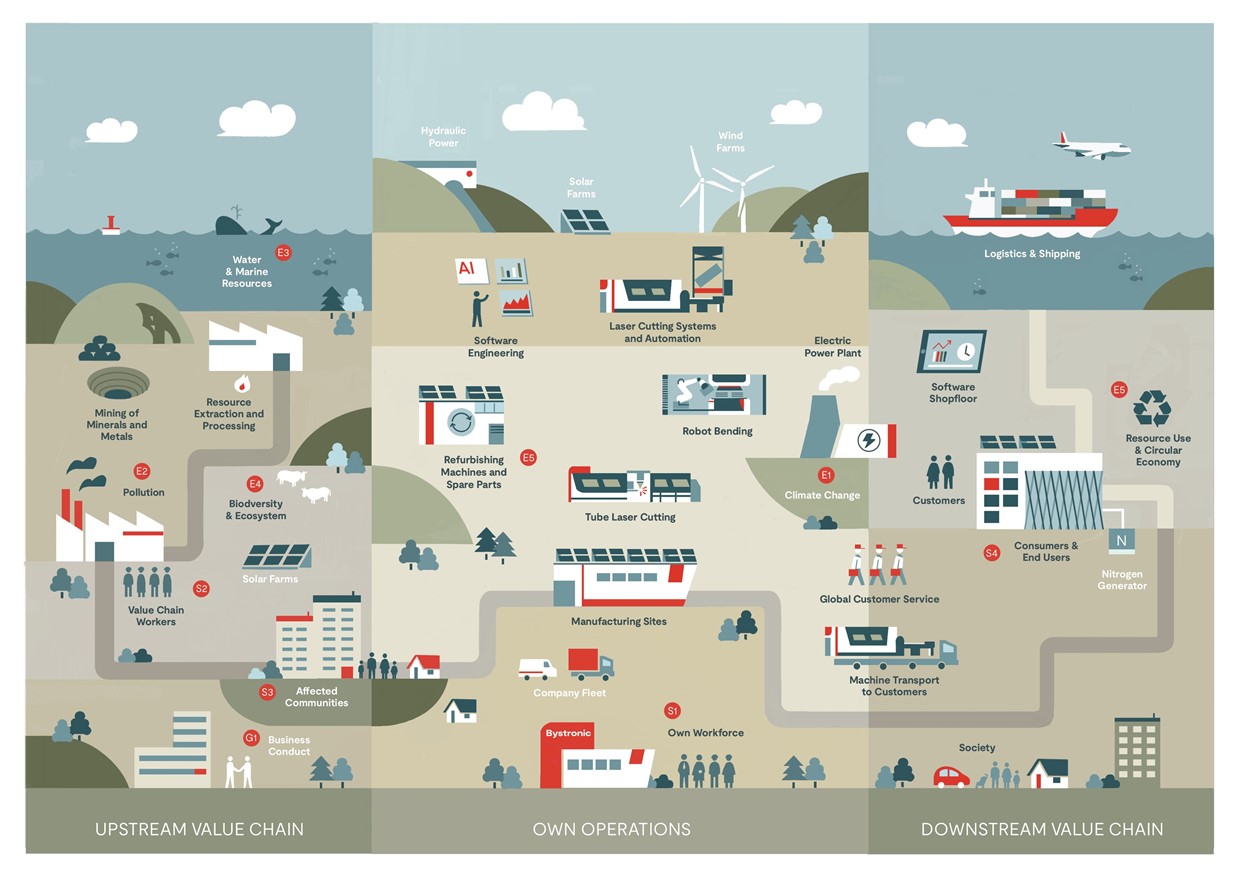
Based on the double materiality assessment described above, seven topics met the materiality threshold and require detailed disclosure under the corresponding ESRS topical standards. Three additional topics are monitored but assessed as non-material for this reporting period.
1.6.1.2 Environmental
- E1 Climate Change (high impact, high financial): Climate change creates both risks and opportunities. Transition risks include carbon pricing, energy costs, and regulatory requirements. Physical risks include supply chain disruptions and facility vulnerability. Opportunities arise from customer demand for energy-efficient cleantech solutions enabling their decarbonization (mainly original equipment manufacturers). Our response includes validated Science-Based Targets scope, renewable energy procurement, product energy efficiency improvements, and climate scenario analysis informing adaptation strategy.
- E3 Water & Marine Resources (low impact, medium financial): While direct water consumption is modest, certain facilities operate in water-stressed regions, notably Tianjin, China. Supply chain water risks could create business continuity challenges. Water management supports a license to operate. Our response includes the WRI Aqueduct4 risk assessment for all sites, water consumption monitoring, closed-loop systems where feasible, and wastewater treatment compliance.
- E5 Circular Economy & Resource Use (high impact, high financial): Material efficiency and waste reduction address costs, supply constraints, and environmental impacts. Our approach is to create customer value through refurbishment and upgrading services. Our actions include participation in the Innosuisse circular economy project Circulus, early achievement of waste reduction targets, modular product platforms for upgrades, and product features that enhance maintenance and material efficiency.
1.6.1.3 Social
- S1 Own Workforce (high impact, high financial): Success depends on attracting, developing, and retaining skilled employees in engineering, manufacturing and customer service in competitive talent markets. Material sub-topics include occupational health and safety, diversity and inclusion, training and development, and fair compensation. Our response includes ISO 45001 certification expansion, females proactively included in leadership development programs with coaching tailored to their needs, training investment averaging 16 hours per employee, and fair compensation policies.
- S2 Workers in Value Chain (medium impact, high financial): Supply chain labor practices create reputational risks and potential business continuity issues. Our response includes Supplier Code of Conduct implementation, a Human Rights Policy published in 2024, an annual procurement investigation for child labor and conflict minerals in first tiers of the supply chain, EcoVadis assessments and zero human rights violations identified in 2025.
- S4 Consumers & End-Users (high impact, high financial): Product safety, reliability, and performance are fundamental to customer satisfaction and reputation. Enabling customer sustainability through product features creates competitive differentiation and market opportunities. Our response includes ISO 9001 quality management, extremely low significant product safety incidents, energy efficiency features reducing customer operational costs, LCA data supporting customer Scope 3 reporting, and a responsive service network.
1.6.1.4 Governance
- G1 Business Conduct (medium impact, medium financial): Ethical business practices, anti-corruption controls, data protection, and fair competition are essential for stakeholder trust, regulatory compliance, and sustainable long-term value creation. Governance failures create legal, financial, and reputational risks. Our response includes Code of Conduct and anti-corruption policies, a Business Ethics Hotline with zero retaliation, a goal of zero corruption incidents, General Data Protection Regulation (GDPR) compliance, and regular ethics training.
- Non-material topics (E2 Pollution, E4 Biodiversity, S3 Affected Communities) are monitored for changes and will be re-evaluated in the next assessment cycle in 2027. These topics may become material as regulations evolve or if Bystronicʼs activities change significantly.
1.6.2 Disclosure requirements in ESRS covered by sustainability statement (IRO–2)
The matrix confirms seven material topics requiring detailed topical disclosure. The table below lists all ESRS topics evaluated, indicating which are covered in this statement and which have been assessed as non-material.
)
This sustainability statement covers disclosures required under ESRS 2 General Disclosures and the following topical standards based on materiality assessment results:
- Environmental: ESRS E1 Climate Change (all disclosure requirements), ESRS E3 Water and Marine Resources (E3–1 to E3–3), ESRS E5 Resource Use and Circular Economy (E5–1 to E5–5).
- Social: ESRS S1 Own Workforce (S1–1 to S1–15), ESRS S2 Workers in the Value Chain (S2–1 to S2–5), ESRS S4 Consumers and End-Users (S4–1 to S4–5).
- Governance: ESRS G1 Business Conduct (G1–1 to G1–7).
At Bystronic, we address these disclosures within a sustainability management framework:
- Sustainable solutions: Enable customer decarbonization through energy-efficient products, reducing operational emissions, material optimization software minimizing waste generation, lifecycle extension, and services extending equipment productive life. Our solutions help customers reduce their Scope 1 & 2 emissions while maintaining or improving productivity. For example, product efficiency features include the deep standby chiller achieving up to 50% idle energy reduction, nesting software delivering up to 8% average material waste reduction, and modular platforms enabling upgrades that extend lifecycles five or more years.
- Engaged people: Strengthen workplace safety through health and safety programs. Promote diversity and inclusion with gender balance targets and inclusive culture initiatives. Invest in continuous learning providing technical, leadership, and digital skills development. Ensure fair compensation through market-competitive pay and equal pay for equal work principles.
- Responsible business: Govern transparently with Board of Directors oversight of sustainability and stakeholder engagement. Reduce operational footprint through renewable energy procurement, energy efficiency improvements, and waste reduction. Build resilient and ethical supply chains via supplier assessments, Code of Conduct requirements, and collaborative development. Maintain the highest standards of business conduct through anti-corruption programs, whistleblowing mechanisms, and ethics training.